Tuesday, November 15, 2011

10 Reasons for Organic Food

Day 5:

Organic food is a great way to steer clear of any pesticides. Nutvia created a list of 10 reasons why organic food is better then normal produce. here is a short summary of those reasons. to enter the full list visit the website at the link above.
  1. Organic products meet stringent standards.
  2. Organic food tastes great.
  3. Organic produce reduces health risks.
  4. Organic farms respect our water sources.
  5. Organic framers build soil.
  6. Organic farmers work in harmony with nature.
  7. Organic produces are leaders in innovative research.
  8. Organic products strive to preserve diversity.
  9. Organic farming helps keep rural communities healthy.
  10. Organic abundance – Foods and non-foods alike!
Organic produce not only helps you and your body be more healthy, but it also helps society in general. to prevent intake of any unnecessary pesticides, eat all organic fruits, veggies, meats, and dairy products.
-Roni

Pesticides Extra Article

Day 5:

I was at school today when someone - not naming names - asked me about pesticides. They said, "I read your blog, and I learned that pesticides effect water, air and produce. Do you know if they impact animals as well?" Well,  Anonymous, I spent some time looking on the internet and found out that there is a relationship between animals and pesticides. Some are farm animals that are then killed and sold, while others are wild. Here is an article on how pesticides have reached marine animals as well. Enjoy!

-Roni

It's Not Only In Our Food!!!

Day 5:

While everyone knows about how pesticides have contaminated our food, and I explained in an earlier how it has also contaminated our water, not many know that it is also in the air we are breathing at this very moment. "Research presented in this report indicates that current regulatory attention given to airborne pesticides in California is not adequate to protect human health." This brief summary also states that these pesticides are not only found near the places they are used. Some pesticides used on farm have been found in the air 25 to 50 miles away at a high altitude, near the Sierra Nevada Region. The pesticides have also been found in rain and fog all over California. These is very limited air monitoring in California at the moment and they find these pesticides everywhere. "Of the 26 pesticides monitored as part of the State’s Toxic Air Contaminant Program, 19 were detected in ambient air in and around California communities between 1986 and 1998." The study mentioned in this article also tells about how in 42 of California's 58 counties, there is no air monitoring.  As well as regulators not being able to check the air for almost 100 more pesticides used in California. Quotes used in this post were found in ( http://www.environmentcalifornia.org/reports/environmental-health/environmental-health-reports/poisoning-the-air-airborne-pesticides-in-california )

-Roni

Monday, November 14, 2011

2,4-D is Linked to Cancer

Day 4:

Although there is no evident proof, a study was conducted to see if there was a link between cancer and pesticides. "The most convincing evidence that pesticides are carcinogens comes from epidemiological studies.  Farmers who frequently use 2,4-D have a six-fold increase in non-Hodgkin’s lymphoma." This means that 2,4-D (2,4-Dichlorophenoxyacetic acid) - a systemic pesticide that is used specifically to control broadleaf weeds - have 6 times the chance to be diagnosed with non-Hodgkin’s lymphoma. To learn more about this study go to the link below and to learn more about pesticides and cancer, visit our Videos page and watch the video.

-Roni

How Toxic ARE Pesticides?

Day 4:

As you all know, pesticides that are known PAN Bad Actors can be cancerous, but how else are pesticides toxic?  Since there are many different types of pesticides, I can't go over all of the symptoms of every type of pesticide, but here are some of the ones that seemed to pop up a lot.  For a complete table with many more pesticides click on the Pesticide Symptoms link in the sidebar.  A lot of the pesticides seemed to have symptoms like irritating of the skin and throat.  Nearly every pesticide caused headaches.  Some of the brands even caused visual disturbances, such as blurred vision, halos, and blinds spots.  Lots of the pesticides caused stomach aches and vomiting.  Finally, PAN Bad Actors are neurotoxins, meaning that they effect the transmission of chemicals between neurons.  You should definitely make sure to protect yourself from pesticides!

-Seth

Pesticides: A Complete History

Day 4:

Since the beginning of time (7000 B.C.), people looked for ways to keep insects and other animals from eating their crops. Some cultures selected naturally resistant crops, others picked bugs off by hand in order to keep them from being destroyed. In the late 1800's, people started developing chemicals to repel pests from their crops. In the 1870's, people learned how to protect their potatoes by using water-insoluble chemicals such as paris green. Over time people learned to create more and more chemicals to keep their crops from being eaten, and each one was stronger then the previous. It was only in the 1950's when people started seeing their affects. "When they were introduced, pesticides were seen as a wonderful technology that would increase crop yields and reduce insect-borne diseases. The first sign that this was a hopeful myth was the discovery in the 1950s that pesticide volume must be increased to have the same effect it once had. With the publication of Silent Spring by Rachel Carson in 1962, an awareness of the danger of unrestricted pesticide use grew." This was because once the pesticides were being used, pests became resistant, and therefore people created stronger ones to keep insects away. People soon found out that pesticides weren't only bad for the people eating the plants, but also for animals such as birds because the pesticides caused problems with their eggs, leading to extinction. 
To learn more on the development of pesticides over time, go to this link 

-Roni

Pesticides Though The Generations

Day 4:

Most people think that once you wash you food, you're safe to eat it. But the truth is, that sometimes even washing won't get your produce rid of pesticides. Others say, so what if I eat pesticides, it rarely ever has effects on my life. And even though that's true, it may have an impact on your children's lives, especially for females. When you digest pesticides, your body stores them in your fat deposits, were they can cause severe damage to you body. For females, these bad chemicals that your body stores can be passed down to the fetus during the pregnancy. It can also be transmitted through breast milk. The source (link shown below) also states "Children eating foods that have been treated with hormones, antibiotics or pesticides, have them in their bodies." The lesson is watch what you eat, because it can change the fate of your kids, and their kids, and their kids, and so on...
Here is the link ( http://www.purezing.com/living/toxins/living_toxins_dangerouspesticides.html )

-Roni

Thursday, November 10, 2011

Pesticides in Water

Day 3:

Today during class I looked up how pesticides can enter out drinking water. The site says that about 90% of the population depends on ground water for drinking usess. People think that the water if filtered but it might not be. "Pesticides can reach water-bearing aquifers below ground from applications onto crop fields, seepage of contaminated surface water, accidental spills and leaks, improper disposal, and even through injection waste material into wells." This image might help you understand.
It also explains how it may take decades for pesticides to be found in ground water. If you want to know more, go to this link. ( http://ga.water.usgs.gov/edu/pesticidesgw.html )

-Roni

Pesticides You Can't Wash Off?

Day 3:

Today I found and interesting article. (http://www.motherearthnews.com/organic-gardening/systemic-pesticides-zm0z10zrog.aspx)  The article is about a type of pesticides called systemic pesticides.  Systemic pesticides are a group of pesticides that are actually absorbed into the plant.  Washing or peeling the food won't get rid of the pesticides because the poisonous chemicals become part of the plant tissue.  Systemic pesticides can be applied to the fully grown plants or to seeds.  Just think, even if you do wash all your fruits and vegetables, and peel them, you will NEVER be safe from pesticides!

-Seth

Wednesday, November 9, 2011

How Are Pesticides Used On Crops?

Day 2:

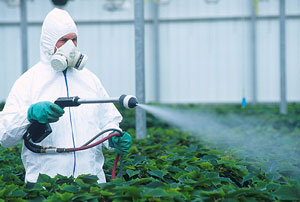
Pesticides are used mainly on produce in order to protect the crops from being eaten away. Here are some ways that they are used. They can be sprayed on by...
Hose,

Tractor,

 Automatic Sprinklers,

And last but not least, planes.

(All photo's used above and their links can be found in out Photo Gallery)

-Roni


So Many Pesticides!!!!!

Day 2:


Today in class, we looked up information on what is a pesticide and what problems do they cause. So we explored the PAN Pesticide Database and found many interesting facts. Did you know that certain pesticides are classified as PAN Bad Actors. PAN Bad Actor pesticides are at least one of the following: Known or probable carcinogens, reproductive or developmental toxicants, neurotoxic cholinesterase inhibitors, or known groundwater contaminants. If you look at the amount of PAN Bad Actors in most crops we grow in California, it's absurd! All these plants are contaminated with pounds and pound of these different PAN Bad Actors every year just to keep pests away. But it's not just in our plants, its in our produce to.


-Roni

Chemical Formula of Pesticides

Day 2:

I went online to the PAN pesticide database (link on the side) and looked at the pesticides used in our county.  One of the first pesticides to come up is sulfuryl flouride, a known PAN Bad Actor.  The chemical formula for sulfuryl flouride, also known as sulfuryl oxyflouride, is F2O2S.  This means it has two flouride atoms, two oxygen atoms and one sulfur atom.  This makes it a compound.  It is a colorless odorless gas.  It belongs to the chemical family of inorganic acid halides.  It is non-corrosive to metals.  When it is heated to decomposition, it emits hydrogen flouride and sulfur dioxide fumes, both of which are extrememly toxic.
(taken from the California CDPR Database linked on the side)

-Seth

Tuesday, November 8, 2011

Change In Plans

Day 1:

Originally, Roni and I wanted to write this blog about Arsenic, per her suggestion.  We started finding information on Arsenic and found some interesting facts about arsenic, but we ran into a problem when we tried to find a video for Arsenic.  There were absolutely no interesting videos about Arsenic, and most of them were 10 minutes long.  We decided we wanted to switch poisons and I suggested pesticides.  Since there are many interesting facts/conspiracy theories involving pesticides I thought it would make for a much more interesting blog.

-Seth